Showing posts with label interests: new acquisitions. Show all posts

Saturday, 28 June 2014

Cox tubular steel furniture. Meeting Mr.Cox / New acquisitions

Andrew Cox with a selection of one-off furniture prototypes
followers of this blog or my work might know that i'm a british tubular chair geek. Sometime last year, Adam Hills of Retrouvius called me, "I've got someone you might want to meet".
After years of assembling an archive of the british tubular steel chair industry i was always led to believe that no manufacturers archives were in existence. until now.
Adam arranged a meeting for me with Mr Andrew Cox (seen above), third generation Cox of Watford Limited, manufacturers of transport seating & metal furniture and in my mind, the leading and far superior name in tubular steel furniture. For many years the Cox family stored a large collection of production samples & prototypes in a number of barns. Adam Hills has found a safe home for many larger pieces but Mr.Cox very kindly invited me to select a number of pieces for my own archive. I can safely say this might be the best hoard I've ever found.
Every piece given is unique to my collection, designs that I've never seen before, designs that never found their way into catalogues. I will be recording every item in the coming months, the majority needs major restoration due to years of barn storage but every piece is unique and incredibly rare. I hope to publish a book and exhibit the collection one day. 
for this blog post i am just showing a few of the pieces you can see surrounding Mr.Cox in the picture above...
 above/below: (chair on left) i thought i had just about every variation of frame design made, but then along comes this very short version, also discovered in a 'sledge' leg base design. Unsure if this is an attempt at a childrens chair, the adult scale and lean to the backrest suggests it may be an adults beach or lawn concert chair.

 above/below: This is perhaps this most important and rarest piece in my collection. When Mr.Cox (Andrew's father) announced that he was having a child, the factory made him a cot. made from the same tubular steel used to make chairs and what ever could be found in the Watford factory.
below: By the same school of thought that a rare plywood leg splint is coveted by the Charles Eames collector, a Cox stretcher is surely the holy grail of all Cox designs to me. however, the design may seem fimilair to Londoners, many hundreds were recycled after the war to replace iron railings removed around churches, you can often spot them around modernist council estate green areas.
during the war, the Cox factory workers skills & machinery aided the war effort producing tubular steel stretchers with a grid mesh infill. as with many Cox pieces, these were designed to interlock and stack together tightly.

above/below: large table, unsure if this is a dining or work table, great simple cross stretcher design, one of many table variations discovered
...this is just a very small sample of the pieces found, much more coming soon. Thank you to Adam Hills at Retrouvius and Andrew Cox for his outstanding kindness and support.

Sunday, 7 July 2013

cardboard box love

Selfridges
 regular readers of my blog will know i'm a bit of a cardboard box nerd. here is a selection of what i call 'shop shirt boxes'. These were all found in car boot sales and house clearances. Originally produced by high end retailers to present or post goods, garments and alterations to customers. Always constructed from a hard-wall cardboard with metal stapled joints, never from cheaper corrugated cardboard. often, but not always designed with an area to label the recipient's address. double click images to view larger.
Burberrys
John Lewis 
Jenners
Asprey
Harrods 
Harrods
Harvey Nichols
Liberty
Liberty
Simpson - great carry handle detail
Garrard & Co Ltd
Peter Jones (John Lewis)
Anderson & Sheppard, Savile Row
Tobias Bros
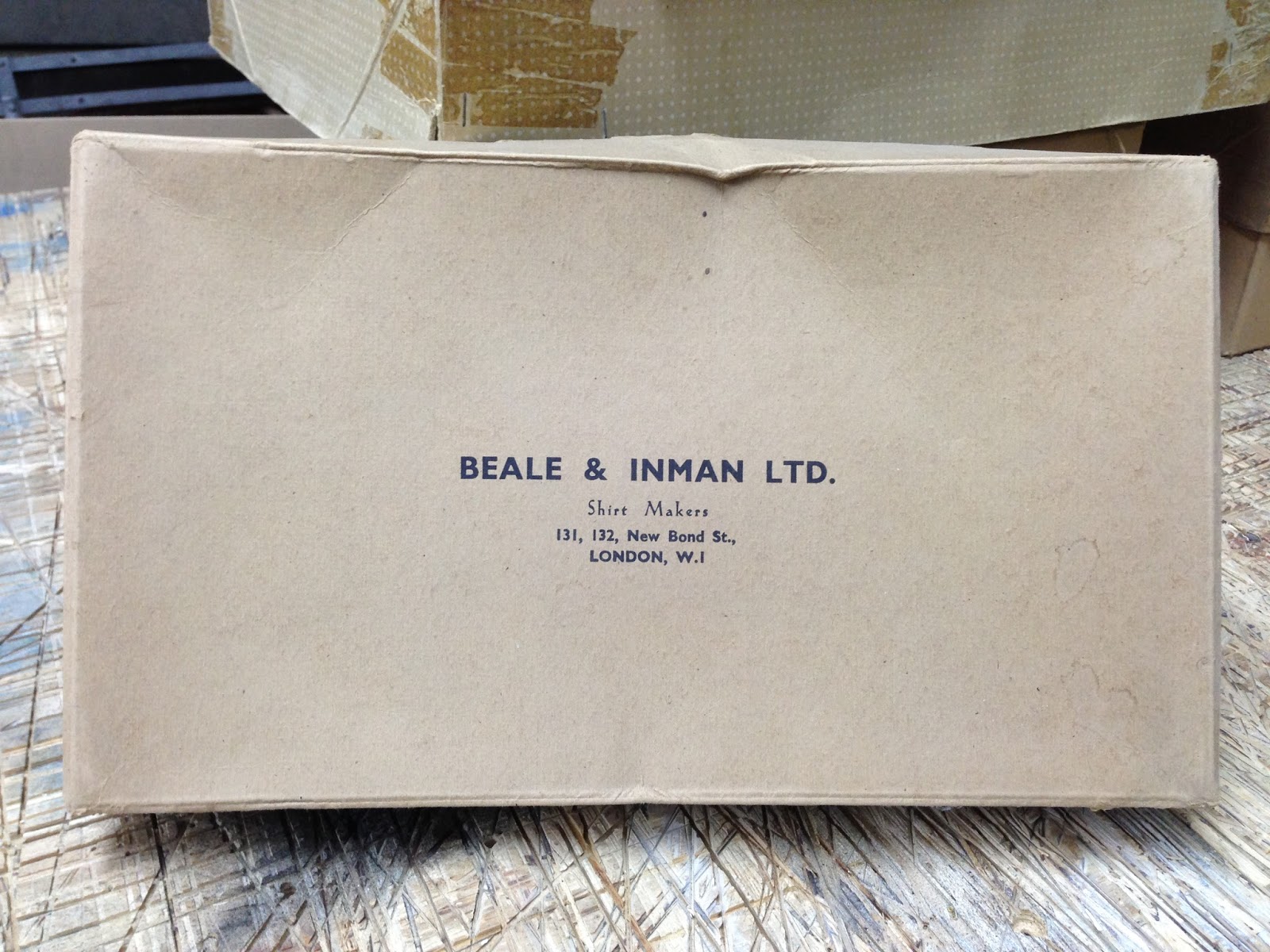
Beale & Inman Ltd 
Marshall & Snelgrove
Schofields Ltd 
Lovely telephone number change/correction on the Schofields box
Detail on John Lewis box: 'Must arrive Wednesday, Customer going on holiday' 

Monday, 26 March 2012

new acquisition - cox stacking chairs

 a recent acquisition, an interesting pair of Cox stacking chairs.
these were one of Cox's attempts to diversify. a hybrid of styles, the classic tubular steel frame with plywood backrest, a church chair type solid wood shaped seat pad which is thought to be out sourced and made by another company. the front section of the framework is made with box section steel rather than tubular -an interesting experiment for cox, the box section is thought to be ice-bent
above: a pair of stacking chairs.
i doubt that this was very successful, you don't find them as often as the standard cox/pel stacking chairs. it is also much heavier than other Cox designs with the solid seat and thick wall box section steel. there is a design fault in the front legs as they appear to bend out of shape with heavy use.
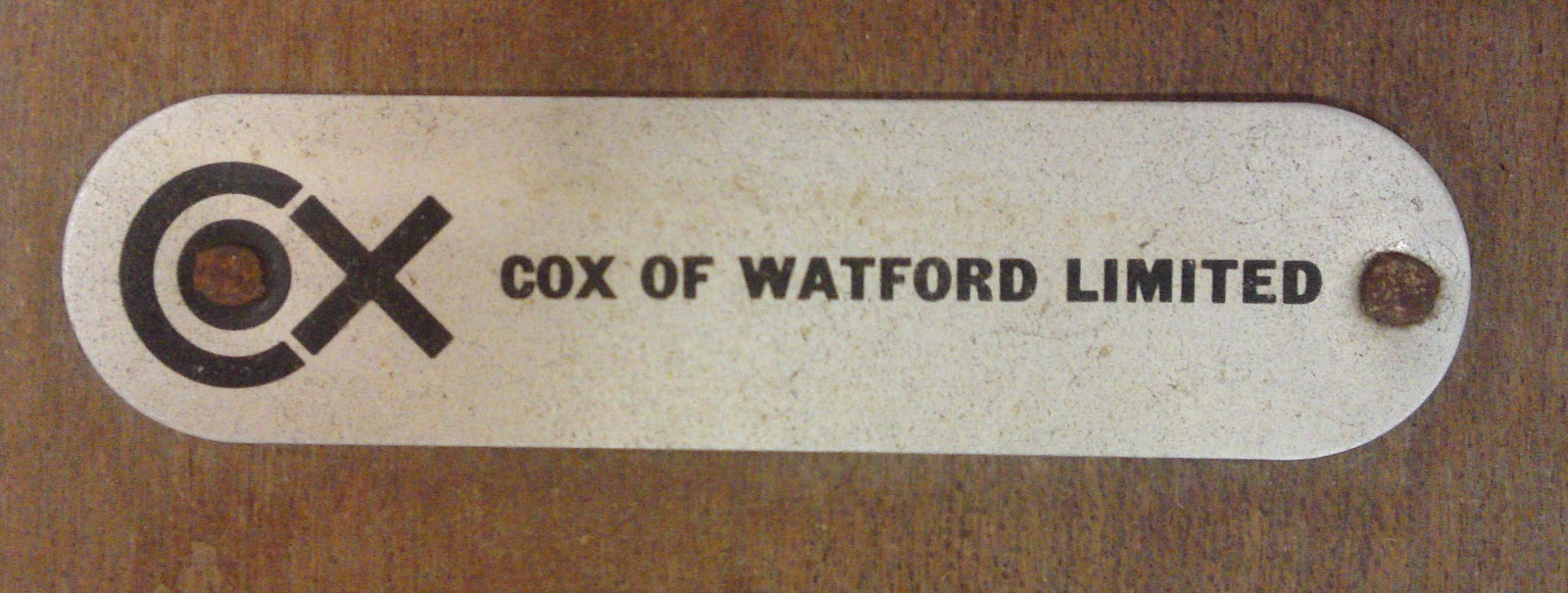
 Below: makers marks
both chairs are from the same source, they appear to be of the same age and have the same degree of wear however they have very different designs of makers marks.
if you were to buy these chairs from an unscrupulous dealer then you might be told that one chair is from the 1930s/40s and the other was from the 1960's - however the makers marks are rather misleading as they both date from the 1960s but it is common for both Cox/Pel to 'use-up' any old spare parts, badges, bits & bobs to finish the order, these were made in a british make-do-and-mend era.
 above: what appears to be a 30s/40s makers badge (wartime logo) ...little thought of where to place the nails.
below: what appears to be a 60's makers badge (fish logo) ...too much thought of where to place the nails

Friday, 16 March 2012

Bruno Besagni horse lamps

i have found a few of these painted plaster horse lamps over the years but never really knew much about them. the one above is from my own collection but it has been on loan to Time Based Arts at Shoreditch Town Hall while i restore one for them. i bought my first one about ten years ago in the old Coppermill indoor market just off Brick Lane (now knocked down).
a few months back, while searching through Spitalfields Life i found these pictures...
...it's Bruno Besagni!
the original maker - he should put them back into production as i can't find them fast enough.
amazing to read about him and find out that this design that i have loved for so long was made in East London. you can read more about Bruno on Spitalfields Life HERE.
 Bruno at work
above: Polly working hard in her studio carefully restoring a very chipped up horse lamp to be delivered to Time Based Arts soon
 above: a couple of winners.
the shade on the left is not original to the lamp base, its a 50s american shade.
interesting how the same lamp can be found in different states of decoration - the one on the right has much more detail with a lot more care taken over the paintwork
 above: the rear of the lamp with the 'BB' Bruno Besagni makers mark and reg'design number
what a beauty

Sunday, 26 February 2012

Pel chair by post - tubular spring chair by Biddulph Industries Ltd

 one of two missing chairs from my incomplete collection of tubular steel stacking chairs has finally returned home.
a recent find on ebay. made in Llysfaen, North Wales by Biddulph Industries Ltd it is thought that the frames may well have been made in nearby factories in the midlands before the springs with their plastic covers were added. years ago, i found a large job-lot of these chairs with grey frames and regretted not keeping a single chair -at last one has joined the collection.
 below- a clear transfer makers logo with an almost worn away production item number transfer.

Saturday, 14 January 2012

Rare Mk1 Workmate made for Black and Decker by Mate Tools ltd, Hoddesdon, Herts.

Regular visitors to my blog will know that i am a big fan of everyday design and a bit of a workmate nerd. This morning at 5.30am in the cold and dark at a car boot sale i found the holy grail of all workmates for less than the price of a bacon sandwich. Although i have over 20 workmates in my collection this is the first ever Mk1...
...very thick 2inch solid beech vice with interesting folding handles that don't appear on any of the later models as they can be rather hard to use. the instruction sticker on the wood states 'made exclusively for Black and Decker by Mate Tools' so it must date from the early 1970s.
 Above: the triangular mark towards the base is the 'as selected for the Design Centre London' sticker.
the overall height is surprisingly low but this is explained partly by the original design intention that the workmate was to replace the use of a dining chair as an ad-hock saw horse. i wonder if this might be part of the attraction of the workmate to me as i am a huge chair design fan and actively deter the misuse of chairs - chairs are not ladders people!
Below: cast aluminium frame with 'mate tool limited' makers mark
see more workmates here
A background text from www.ingenious.org.uk :
South African Ronald Price Hickman was a design engineer working for Lotus, the sports car manufacturer. He was also a keen DIYer. The idea for his invention of the famous ‘Workmate’ workbench-cum-vice-cum-sawhorse came to him after he cut up a large piece of plywood, in a cramped space, using a Windsor chair for support. When he finished sawing he realised with irritation that he had damaged the chair beneath. So he set about designing, for his own use, a compact foldable and portable bench, which could be set up anywhere and taken easily from room to room. The work surface comprised two 27-inch lengths of 5-inch x 2-inch beechwood, one of which could be moved as a giant vice jaw against the other, to grip large or irregular-shaped objects. The two lengths of beechwood were mounted on a lightweight aluminium alloy and steel frame, with a footboard at the base. The user could stand on this to give rigidity and stability to the structure. The work surface could even be used as a seat while planing, and power tools and extra vices could be mounted on the jaws and work clamped to them. When not in use the workbench could be folded up to suitcase size and hung on a wall.Hickman believed he had created something that every DIYer would want, so he showed it to the tool manufacturers. His earliest design, dating from 1967, was turned down by Black & Decker. After failing to interest a further seven companies, Hickman wisely patented his idea and decided to manufacture the bench himself in 1968, trading as Mate Tools Ltd, in the old brewery building in Brewery Lane, Hoddesdon, in Hertfordshire. Over the next four years about 25,000 units were made and sold. Then, in 1972, Black & Decker came back to Hickman, who granted them a licence to the production rights of a new design, the Mark II Workmate, for which they took over manufacture in the UK. Black & Decker finally started production in the US in 1975, after a great struggle to convince the parent company of its potential. The rest, as they say, is history. Over sixty million Workmates have been sold around the world.